Archive | Architecture

Tags: , , , , , ,

Jean Nouvel Designs 2010 Serpentine Gallery Pavilion

Posted on 06 July 2010 by anc

World renowned French architect Jean Nouvel has designed England’s 2010 Serpentine Gallery Pavilion. (Several images below!) Launched in 2000, this ongoing, annual commission invites internationally acclaimed architects and designers to create a temporary (3-month) structure on the Gallery’s lawn. The entire process allots only six months from invitation to completion, an opportunity to demonstrate each designer or architect’s skill and talent.

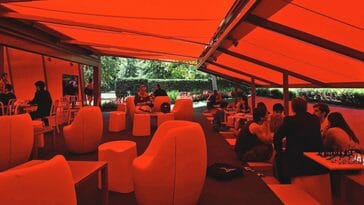
This year, the gallery celebrates its 40th anniversary, and Nouvel’s project is his first completed building in the UK. A contrast of lightweight materials and dramatic, metal cantilevered structures, Nouvel’s entire design is rendered in a vivid red that simultaneously contrasts with the green of its park setting. The color reflects the iconic British images of traditional telephone boxes, post boxes and London buses. The building consists of bold geometric forms, large retractable awnings and a freestanding wall that climbs 12m above the lawn, sloping at a gravity defying angle. Glass, polycarbonate and fabric structures create a versatile system of interior and exterior spaces.

Around the Pavilion, Nouvel has created spaces for outdoor play, bringing the tradition of French civic parks to London. Red table tennis tables, draughts, chess, frisbees and kites will be available for the public to play with throughout the summer months. The flexible auditorium will accommodate the Serpentine Gallery café, as well as Park Nights, the Gallery’s lecture and event program, and will culminate in the annual Serpentine Gallery Marathon on October 16th and 17th. The theme of the 5th Serpentine Gallery Marathon – The Marathon of Maps for the 21 Century – considers maps’ hold on our imaginations, and their ability to define our understanding of geography, scale, space and ideas. During the event, artists, writers and scientists will present maps encompassing their experience of the world today.

Jean Nouvel is responsible for the design of over 200 buildings the world over, including the Copenhagen Concert Hall (2009); the Ferrari Factory, Modena (2009); 40 Mercer Street, New York (2008); the Musée du quai Branly, Paris (2006); the extension to the Museo Nacional Centro de Arte Reina Sofía, Madrid (2006); the Guthrie Theater, Minneapolis (2001); the Torre Agbar, Barcelona (2000); the Culture and Congress Centre, Lucerne (2000), and the Institut du Monde Arabe, Paris (1989). (Images below!)

Previous Pavilion architects include: Kazuyo Sejima and Ryue Nishizawa, SANAA, 2009; Frank Gehry, 2008; Olafur Eliasson and Kjetil Thorsen, 2007; Rem Koolhaas and Cecil Balmond, with Arup, 2006; Álvaro Siza and Eduardo Souto de Moura with Cecil Balmond, Arup, 2005; MVRDV with Arup, 2004 (un-realised); Oscar Niemeyer, 2003; Toyo Ito with Arup, 2002; Daniel Libeskind with Arup, 2001; and Zaha Hadid, 2000.


*above: Jean Nouvel. Photograph © Gaston Bergeret


*above: Serpentine Gallery Pavilion 2010, Designed by Jean Nouvel. © Ateliers Jean Nouvel.


*above: Serpentine Gallery Pavilion 2010, Designed by Jean Nouvel. © Ateliers Jean Nouvel. Photograph: Philippe Ruault


*above: Serpentine Gallery Pavilion 2010, Designed by Jean Nouvel. © Ateliers Jean Nouvel.


*above: Serpentine Gallery Pavilion 2010, Designed by Jean Nouvel. © Ateliers Jean Nouvel. Photograph: Philippe Ruault


*above: Serpentine Gallery Pavilion 2010, Designed by Jean Nouvel. © Ateliers Jean Nouvel. Photograph: Philippe Ruault


*above: Serpentine Gallery Pavilion 2010, Designed by Jean Nouvel. © Ateliers Jean Nouvel. Photograph: Philippe Ruault


*above:Jean Nouvel, Fondation Cartier pour l’art contemporain, Paris, 1991-95. © Jean Nouvel. Photograph: Philippe Ruault


*above: Jean Nouvel, Louvre Abu Dhabi, Abu Dhabi, 2007. © Jean Nouvel


*above: Jean Nouvel, Agbar Tower, Barcelona, 1999-2005. © Jean Nouvel. Photograph: Philippe Ruault

*All images courtesy of Serpentine Gallery.

View Comments

Tags: , , , , ,

Zaha Hadid: The Glace Collection for Swarovski

Posted on 24 June 2010 by anc

One of the world’s most renowned architects, Zaha Hadid has been celebrated for a one-of-a-kind architectural language, based on fluid, organic shapes, always seemingly just beyond this world. For Summer 2010, she’s bringing her same creative language to a jewelry collection for Atelier Swarovski.

The Glace collection, as its called, consists of five pieces – bracelets, necklaces and rings – designed to be dramatically worn individually or as complementary pieces together. Each sculpted piece features colorful crystals suspended in clear resin, and every piece is available as one of only 50 in the exclusive collection.

According to Ms. Hadid:
“This enigmatic new Glace collection celebrates a powerful dichotomy between the purity of Swarovski’s precision cut crystals and the subtle, organic forms that envelop them. Each piece within the collection has evolved as an abstraction of the sinuous forms evident in nature, revealing my desire for experimentation and invention throughout every stage of design and realization.”

A selection from the new line is below; for more information, visit atelierswarovski.com.


*above: Zaha Hadid Pendant Jet


*above: Zaha Hadid Flame Cuffs


*above: Zaha Hadid Collar Opal


*above: Zaha Hadid Ring 1 +2 Crystal


*above: Zaha Hadid Jet Bangles

*All images courtesy of Atelier Swarovksi.

View Comments

Tags: , , , , , , , , , ,

Container Atlas: A Practical Guide to Container Architecture

Posted on 10 June 2010 by anc

An in-depth, thoughtful look at the history, evolution and current state of container architecture, Gestalten‘s latest title – Container Atlas: A Practical Guide to Container Architecture – is an informative, visually stimulating collection of examples of this “contemporary architectural phenomenon.”

The book’s introduction provides background on the container story, taking readers back to the early 20th century, when former trucking entrepreneur Malcolm McLean began to push for the implementation of standardized containers for universal freight transport, and through to the steel boxes’ role in US Army logistical operations of World War II. But it’s the visual examination of these containers’ prevalent roles in contemporary society that demands the most attention. For example, their use in :

Social/low budget architecture: Since the containers are accessible and functional, they are suitable for use in charitable organizations funded by donations, such as Melbourne’s Children’s Activity Centre (Phooey Architects), made of four shipping containers transformed into a social facility for children.

Events/exhibitions/installations: Such as architect Shigeru Ban‘s Nomadic Museum, which employs containers in two ways: as building blocks that form the supporting structure for the exhibit hall, and as transport containers for building elements and for the display specimens themselves.

Commercial/corporate architecture: Such as the mobile PUMA salesroom by LOT-EK, consising of 24 shipping containers staggered to form a three-story building.

…as well as examples of housing, public buildings, offices, art and more.

In addition to gorgeous photos of existing container architecture (check out a sampling of images below!) Container Atlas also includes plans and associated costs for each project. It even suggests solutions for common problems in the arena, making it a reliable reference for everyone from professional architects and planners to marketing managers and the general public.

Container Atlas
A Practical Guide to Container Architecture
Editors: H. Slawik, J. Bergmann, M. Buchmeier, S. Tinney
Published by: Gestalten
Price: € 49,90 / $ 78,00 / £ 45,00
Format: 24 x 30 cm
Features: 256 pages, full color, hardcover

Available now from Amazon or Gestalten.

*All images from Container Atlas: A Practical Guide to Container Architecture, © Gestalten 2010.

View Comments

Tags: , , , , , ,

Modern Visions: David Tajchman Architecture

Posted on 27 April 2010 by anc

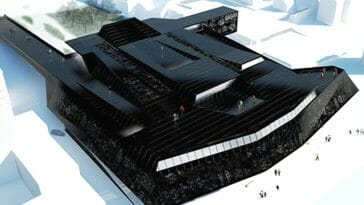
Architect David Tajchman recently earned an honorable mention for his futuristic “Stealth” design proposal for the new visual arts Maribor Museum in Slovenia.

As shown below, the museum’s external design reinterprets the Slovenian lacework tradition, with perforated patterns that filter natural light for the exhibitions spaces within. Similar patterns are used on flooring inside to make surfaces non-slippery, and to hide technical elements (air conditioners, etc.) on the ceilings. Removable partition walls inside slip from structural elements that provide storage or cover technical elements to subdivide the exhibition spaces.

According to Tajchman, “Like a stealth, the project is inserted in the city in direct visual
and morphologic relation with its context.” In his vision, people pass through the covered ground floor, an open public space for outdoor protected activities of the UGM. in this way, the project aims to encourage visual connections between the old and the modern city. Maribor sits at the crosspoint of the Alps, Adriatic and the Balkans. Other art cities such as Venice, Vienna, Graz and Budapest are a close trainride away.

WIth offices in both Paris and Brussels since 2009, Tajchman keeps busy creating dramatic works of art across the globe, and teaching with Sir Peter Cook at Ecole Spéciale d’Architecture in Paris.

Project Info:
Stealth: New Maribor Museum Architecture Competition
Place: Maribor, Slovenia
Area: 15000 m2
Client: UGM
Architect: David Tajchman
Intern: Luke Izri
Results: 4th prize – honorable mention

*Images courtesy of Architectures David Tajchman.

View Comments

Tags: , , , , , , , , , , , , , , , , , , ,

The State of Things: Design Museum Holon

Posted on 01 March 2010 by anc

This week, the Design Museum Holon presents its inaugural exhibition: “The State of Things: Design and the 21st Century.” Opening March 4th and running through May 15th, the exhibit – which takes place in the new Ron Arad-designed, Israeli building – features more than 100 objects that collectively reflect issues concerning the practice, consumption and cultural impact of contemporary international design.


*above: Design Museum Holon, by Ron Arad Architects

The star-studded cast of contributing designers includes Maarten Baas, Jaime Hayon, Max Lamb, Joris Laarman, Front, Yves Behar, Stephen Burks, Tokujin Yoshioka, Konstantin Grcic, POLKA, Tom Dixon, Ingo Maurer, the Campana Brothers and Dror Benshetrit, among others.


*above: “Cabbage Chair” by Nendo

The curated objects range from ordinary household items to life-enhancing and saving technologies. According to Design Museum Holon Creative Director, Galit Gaon: “The museum is committed to showcasing the importance of quality design and its relevance to our lives at this particular point in time; the objects in the exhibition will reveal the same ingenuity and poetry evident in the new Ron Arad building that will house them.”


*above: “Wiek Cabinet” by Maarten Baas


*above: “Brave New World Lamp” by Moooi

Each grouping of works represents a contemporary category. Whether through the materials employed, the concepts conveyed, or the uses intended, these objects reflect our times so acutely that they could only have been made in the last few years: thus, the current “state of things.”


*above: “Cappellini Love Table” by Stephen Burks

For more information on the new Design Museum Holon, check out www.dmh.org.
Tel: +972 7 32151515
Fax: +972 3 6520331

*Images courtesy of Design Museum Holon.

View Comments

Tags: , , , , , , ,

Ernesto Neto’s “Navedenga”

Posted on 10 February 2010 by anc

Since the late 1990s, Brazilian artist Ernesto Neto has created interactive, immersive sculptural environments using translucent, stretchable fabrics. “Navedenga” (1998) – one of Neto’s early, quasi-architectural bodies – is on view now at the Museum of Modern Art through late April.

The enveloping sculptural environment invites the audience to participate in a work of art, as they enter the sculpture’s hollow chamber and engage it with their visual, tactile, and olfactory senses. Responsive to the touch, “Navedenga” was constructed from Lycra fabric, Styrofoam and sand, and embedded with aromatic cloves. Its soft, sensuous surface, and round, taut contours reference and evoke the human body.

The installation’s form and the title—a neologism created by the artist that recalls the Portuguese word “nave,” or “ship”—suggest both a fantastical spacecraft and a protective womb. It’s part of a series of “naves” by Neto, alluding to journeys both intimate and expansive, feminine and masculine.

For more information, visit MoMA.org.
All images courtesy of the Museum of Modern Art:
Ernesto Neto, “Navedenga.” 1998. Polyamide stretch fabric, sand, Styrofoam, cloves, cord, and ribbon. 144 x 180 x 252″ (365.8 x 457.2 x 640.1 cm). The Museum of Modern Art, New York. Gift of Donald L. Bryant, Jr. Installation photographed at The Museum of Modern Art, 2010. Photo © 2010 Jason Mandella.

View Comments

Tags: , , , , , , , ,

Visual Acoustics

Posted on 30 September 2009 by anc

“Architecture affects everybody…” Julius Shulman once said. And he’s right – it’s all around us, and far too often taken for granted. Sadly, Shulman passed away earlier this year. Now, director Erik Bricker‘s new documentary, “Visual Acoustics: The Modernism of Julius Shulman,” celebrates Shulman’s life and work as the world’s greatest architectural photographer.

Click HERE for a list of screenings.

And check out Dwell Magazine‘s interview with director Erik Bricker HERE.

H/T FreshCreation

View Comments

Tags: , , , , , , , ,

"No Discipline" at MoMA

Posted on 03 August 2009 by anc

Installation view of Ron Arad: No Discipline at The Museum of Modern Art. Photo: Jason Mandella.

Installation view of Ron Arad: No Discipline at The Museum of Modern Art. Photo: Jason Mandella.


Installation view of Ron Arad: No Discipline at The Museum of Modern Art. Photo: Jason Mandella.

Installation view of Ron Arad: No Discipline at The Museum of Modern Art. Photo: Jason Mandella.


Sketch for Southern Hemisphere. 2007 N.d. Courtesy of Ron Arad Associates, London

Sketch for Southern Hemisphere. 2007 N.d. Courtesy of Ron Arad Associates, London


Oh-Void 2. 2006 Acrylic; Edition by The Gallery Mourmans, The Netherlands Photo courtesy of Private Collection, U.S. Photo Erik and Petra Hesmerg

Oh-Void 2. 2006 Acrylic; Edition by The Gallery Mourmans, The Netherlands Photo courtesy of Private Collection, U.S. Photo Erik and Petra Hesmerg

Creative Playboy:

Ron Arad may not be a familiar name to most of the population, but in the art and design world, he’s regarded as a bit of a bad-boy genius, known both for blending the worlds of design, art and architecture and a strong personality. On a recent July morning at MoMA, though, during a preview for “No Discipline,” the first major U.S. retrospective of Arad’s work running through October 19th, despite others’ best efforts to place the bad boy persona on center stage, Arad just let the work speak for itself.

First on the agenda was an exhibition walk-through. “No Discipline” presents a career’s worth of work organized by what Senior Curator of Design & Architecture Paola Antonelli calls “families:” related pieces sit on, within and outside a massive figure-eight structure that takes up most of the room, referencing the recurrence of the shape in Arad’s work. Screens throughout show video of Arad’s work, as well as a stop-motion video of the enormous figure eight’s installment. It was potent, and as I walked around, I was repeatedly asked to step out of the way for other hungry pressman eager to snap shots of – what?!- no curmudgeon, rather an agreeably posing Arad.

Next up: comments by MoMA Director Glenn Lowry and Paola Antonelli. Both made all the appropriate thank-yous, and Lowry put the exhibit in context: “This museum, as I think all of you know, really grew out of a deep commitment and belief in the fact that modern art expressed itself across many different media and disciplines…Ron stands out as one of the most influential designers of our time for his adventurous approach to form, structure, technology and materials, in work that spans the disciplines of industrial design, sculpture, architecture and mixed media installations…His relentless experimentation of materials of all kinds, as well as his radical reinterpretation of some of the most established archetypes in furniture that put him at the forefront of contemporary design. Ron, we’re so thrilled that you are with us today!”

(Applause.)

Then Paola Antonelli: “Ron Arad really did change design history – without really thinking about it – he doesn’t seem to care that much in general – but slowly but surely, one piece after another, and with his tremendous work at the Royal College of Art as head of the Design Products program for ten years….he really shaped – or unshaped and deconstructed – a new generation of designers…”

Speaking of Arad’s approach: “Push to the limit, materials, forms and people around you. It’s really important to push…Designers are those that make revolutions in technology and science and lifestyle, if you wish, come true, and transform them into objects you and I can use… I’d like to answer one question that I’ve had many times from many journalists, I’m going to say it here once and for all…as a very kind correspondent from the BBC very Britishly put it this morning: ‘Um, I have heard that Ron Arad is kind of – has a thing with being – strong willed. How did this exhibition go?’ It was truly a collaboration – it was his creative vision. Well, I was the discipline and he was the No. Blood was shed. It’s on the wall (pointing to the exhibition’s sign, which includes red paint splats, on the wall to her left); the result is fantastic. And we’re still friends. So, there you have it. Thank you!”

(Applause.)

And then the bad boy himself, Arad, dressed in a t-shirt, cap, sneakers and pants a cross between pajamas and hammer-pants, meandered to the podium. After a very quietly spoken thank you to another contributor, he quickly closed, saying, “All the rest is there, I have nothing to say. Enjoy it!”

No drama necessary. Guess we’ll just have to let badass work speak for itself.

For more information on MoMA, visit moma.org
For more information on Ron Arad, check out ronarad.com
Images courtesy of MoMA

Also, check out a great TED design talk by MoMA Senior Curator Paola Antonelli here:

View Comments

Tags: , , , , , , , , , , ,

A Trio Of Great Design Books

Posted on 26 July 2009 by anc

I recently reviewed three great titles for Clear Magazine: Spacecraft 2, KarimSpace, and Marcel Wanders: Behind the Ceiling. Check out snippets from the reviews below!

51x4ZSvkZDL._SL160_

Spacecraft 2: More Fleeting Architecture and Hideouts
Published by Gestalten / $75 / 280 pages
Pushing the limits of classical architecture and satisfying the changing spatial needs of modern life, the projects in Spacecraft 2 demonstrate innovation at its best…inspiring projects by young and little-known artists toy with conventional spatial design and reveal the genuine excitement and possibility that exist in architecture today.

51GYLvEiBYL._SL160_

KarimSpace
by Karim Rashid, forward by Daniel Libeskind
published by Rizzoli/ $86 / 256 pages
Karim Rashid is probably best known for his household designs for Umbra and Method. In KarimSpace, he shares real and conceptual interior projects for restaurants, hotels, residences, retail environments and public areas…his creative process and his ability to combine familiar shape and colors with unexpected materials…Sometimes space-age, sometimes almost biological, the work is always playful, and consistently lives up to Rashid’s definition of design as the “rigorous beautification of our built environments.”

41xvhU5o-xL._SL160_

Marcel Wanders: Behind the Ceiling
by Marcel Wanders
published by Gestalten /$70 / 320 pages
Wanders’ first monograph showcases a decade’s worth of provocative work: from personal art editions to textiles and furniture for clients like B&B Italia, Droog, Cappellini and Moooi, to architecture and interiors for Miami’s Mondrian South Beach Hotel and more. Photos, designer comments and sketches offer readers a first-hand account of Wanders’ world.

**Disclosure: links above are Amazon affiliate links.
To read the full reviews, visit book reviews on my Writing Samples page.

View Comments

Tags: , , , , , , , , , , ,

ARM: Avant Garde Architecture in Melbourne

Posted on 16 July 2009 by anc

MTC facade corner

MTC facade corner

081103_6068 MTC foyer level 1_1 [Gollings]

081103_6143 MTC Sumner Theatre_1 [Gollings]

081103_5977 MRC & MTC facade stormy weather [Gollings]
081103_7200 MRC foyer main stairs [Gollings]
081103_7477 MRC Elisabeth Murdoch Hall balcony_2 [Gollings]
From top: MTC facade corner at twilight; MTC foyer level, MTC Sumner Theatre, MRC & MTC facade, MRC foyer main stairs, MRC Elisabeth Murdoch Hall balcony
**All photographs by John Gollings; Images courtesy of ARM

Australian design consultancy ARM continues to push the envelope down-under. Their latest projects, the Melbourne Recital Centre and  neighboring MTC Theatre, are turning heads round the globe, and recently earned ARM the Public Buildings category award from the Property Council of Australia Rider Levett Bucknall Innovation & Excellence Awards.

One eloquent judge described the projects as “understandable origami.” Looking at the new buildings, you can’t help but notice their strong angles, musical fluidity and theatrical color and shape – beautifully reflecting the spaces’ roles.

According to ARM, the complementary identities of the 1000 seat Recital Centre and 500 seat MTC theatre (both accessed from a landscaped civic plaza on Southbank Boulevard ) together “create an exciting new civic space within Melbourne’s vibrant arts precinct.”

The Melbourne Recital Centre was designed primarily as a chamber music venue. ARM’s design rationale considered the building itself as packaging for the valued music performed within, which led to its “box inside a box” structure. The Elisabeth Murdoch Hall seats 1000, while the Salon space seats 150 for pre-concert talks and experimental chamber music. The performance spaces feature timber panelling for ideal acoustics. Much of the multilevel foyer is visible from the exterior, allowing passersby a peak inside, and concert goers a view of Melbourne’s skyline.

The drama theatre is the first permanent home for the Melbourne Theatre Company. The Sumner Theatre seats 500 in a single tier, and the Lawlor Studio seats 150 for smaller productions. The building’s facade is composed of iridescent painted steel pipework and black aluminum cladding, creating a pattern that “challenges spatial perceptions through the blurring of 2 & 3 dimensional space – that which appears shaped is actually flat, and likewise, a 2 dimensional surface is actually 3 dimensional.”

For more information on ARM, visit www.a-r-m.com.au

View Comments

Share!

| More